Humanizing Healthcare in the Digital Age
Thoughts by Sandeep Sharma, CEO, Vmarsh Healthcare

A thought piece on: Balancing Technology and Human Interventions to Improve Value and Empathetic Patient Care in Today’s Highly Technology-Dependent Times
In today’s rapidly evolving world, technology is advancing at an unprecedented pace and is being imbibed into our day-to-day lives more frequently than ever before. However, we must not forget that we are in the business of healthcare, where “human connection” thereby “emphatic healing” should remain at the core. The key challenge for hospital executives today is to strike that right balance, i.e., between leveraging cutting-edge technology to save costs/increase outputs and yet preserving empathy in patient care. So, let’s begin with understanding where technology is used mostly in healthcare.
Technology in Healthcare
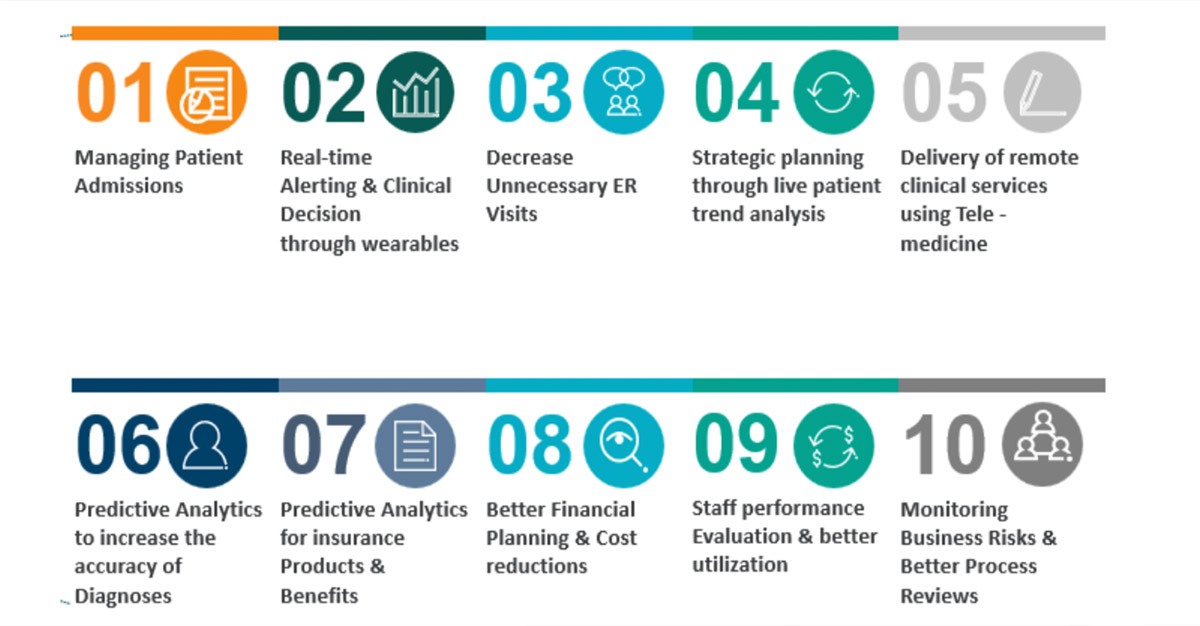
Our Vmarsh team gathered (through secondary research and informal client surveys) in the below figure what summarizes the “Top 10 prominent areas scored where Technology is used in Healthcare”
This makes it clear that technology is not going anywhere, but only getting more anchored across the above depicted areas, as well as making its way to find more novel and innovative uses within healthcare. This brings to mind how the use of technology became so fast-paced and where it all began. So, let’s talk about its adoption.
Adoption of technology in Healthcare
Healthcare, like many other industries, initially focused on data management—prioritizing the storage and organization of information within data warehouses. This evolved into business intelligence, enabling performance management and basic reporting through the use of the stored data. Over the last decade, this trend robustly transformed into a more advanced stages, driven by predictive analysis and a stronger emphasis on Big Data, allowing for more informed and proactive decision-making, which, as a result, brought up the concept of Healthcare known as “Preventive care” which is derived from this philosophy of mining stored data to preempt and solve healthcare problems even before they occur.
However, the story continues beyond that to “Prescriptive care” where AI has come in the picture to go above and beyond simply mining data and presenting it; but running algorithms, doing multiple layers of optimization, comparisons, customizations to a specific individual and serve their titrated needs, which is a step further in “Advanced Analytics” resulting in technology taking the forefront in now prescribing, guiding and navigating Healthcare and Wellbeing; moving “Curative patients” into the “Preventive customers” bucket.
Post Digitization Realities
There is no question that healthcare needs to embrace technology, but it’s important for us to understand some of the key challenges it currently faces.
Here are some of the top operational and informational issues with technology in healthcare:
a. Breach of protected health information – There has been an increasing number of cybersecurity issues private healthcare organisations have faced with breach of health data and its misuse.
b. While the preventive concept works on leveraging “Big Data” i.e. stored data being consolidated and processed to find optimal results. Any altered data that was previously stored may be picked up as a data set and processed as part of analytics, leading to incorrect healthcare decisions given that it took into account altered data.
c. Data management and Integration – This issue is faced by many developed and developing nations and health systems i.e. the integration of HIS from one system to the other. With a vast number of new competitive and innovative HIS tools available, and Healthcare providers opting for a switch in their HIS, faced nightmares to transfer/merge or integrate data sets from one complex system to the other resulting in lost or incomplete data sets leading up to issues with patient diagnosis, prognosis as well as history referencing.
Apart from these operational issues, there are also Interaction and Experience based issues such as:
a. Lately, there has been too much reliance on technology for diagnostic &/or prognostic outcomes, thereby reducing the learning curve for doctors (esp. younger resident doctors); In contrast an decade or two ago doctors would being more hands-on with the patient and less glued to screens due consultations.
b. Given the increased screen time with Doctors more focused reading/typing on their devices during patient consultations, has led to reduced Doctor/Patient Interactions, leaving many patients feeling deprived of empathetic interactions. Ultimately leaving them with sub-optimal patient experience. In summary, despite the best in class treatment and technology at hand, it is “empathy” that patients crave.
Ultimately, on both fronts i.e. “Operational and informational issues” as well as the “Interaction and Experience issues” one thing in common is that, these have added costs to the pocket of patient, the payors and the providers, who are compensating their margins that were depleted due to heavy investments in technology.