AI in Radiology: From Intelligent Imaging to Measurable Clinical Impact
By Dr. Yasmine Maher, CEO Radiology – SEHA / Pure Health
Radiology has always been central to clinical decision-making. Today, with the integration of Artificial Intelligence (AI), it is also emerging as a driver of predictive care, operational excellence, and system-wide transformation.
Across Pure Health Radiology Vertical, AI is embedded into daily clinical workflows—not as an experiment, but as a strategic enabler of safer, faster, and more equitable patient care. The focus is clear: deploy AI where it delivers real clinical impact, while ensuring strong governance and physician leadership remain at the core.
“AI in radiology is not about replacing clinicians; it is about amplifying their impact. Our focus is to deploy AI where it delivers real clinical value—enhancing speed, accuracy, and consistency, while keeping clinical judgment firmly in the hands of our radiologists.” Dr. Yasmine Maher, CEO Radiology – SEHA / PureHealth
Global Perspective
“Artificial intelligence has the potential to improve the quality, safety and productivity of radiology services, provided it is introduced with appropriate clinical governance and oversight.” The Royal College of Radiologists (RCR), UK
Saving Time, Saving Brain: AI-Enabled Early Stroke Detection
Stroke remains one of the most time-critical medical emergencies, where minutes directly influence survival and long-term outcomes. Recognizing this urgency, the Radiology Vertical has prioritized AI-driven stroke solutions as a cornerstone of its digital transformation.
AI tools for early stroke detection and triage are now available across the Radiology Vertical, supporting rapid identification of critical findings on CT and CTA imaging. By enabling faster prioritization and streamlined workflows, these tools strengthen collaboration between radiology, emergency, neurology, and interventional teams—ensuring timely, life-saving decisions.
“Being accredited as centre of excellence for stroke, AI has played a role on how we manage acute stroke imaging accelerating case prioritization and streamlining workflows, AI supports radiologists and stroke teams to act faster—without compromising diagnostic accuracy.”
Dr. Jamal Koutesh, Radiology Vertical Medical Director, Sheikh Tahnoon Medical City Chair and Consultant Interventional Radiologist.
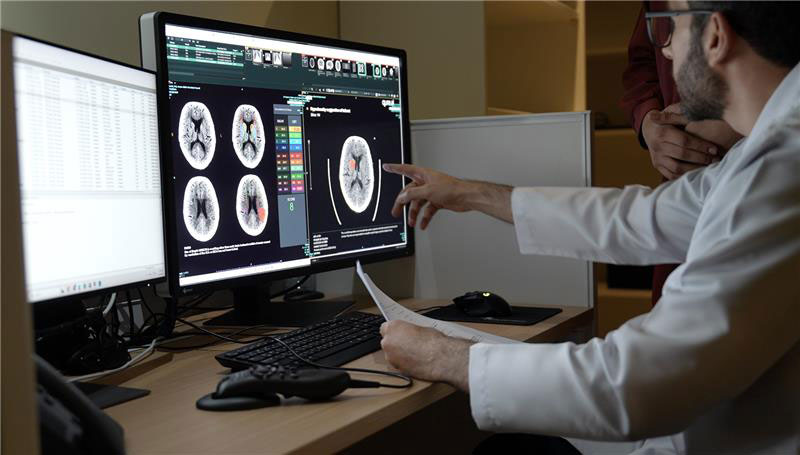
Operational Excellence
The success of AI in radiology depends not only on clinical adoption, but on how effectively it is operationalized across services.

“The real impact of AI is realized when it is fully integrated into workflows, staffing models, and service delivery. From turnaround times to capacity optimization, AI enables more resilient, efficient, and scalable radiology services across the vertical.”
Dr. Daniel Nicula, Director of Operations – Radiology Vertical
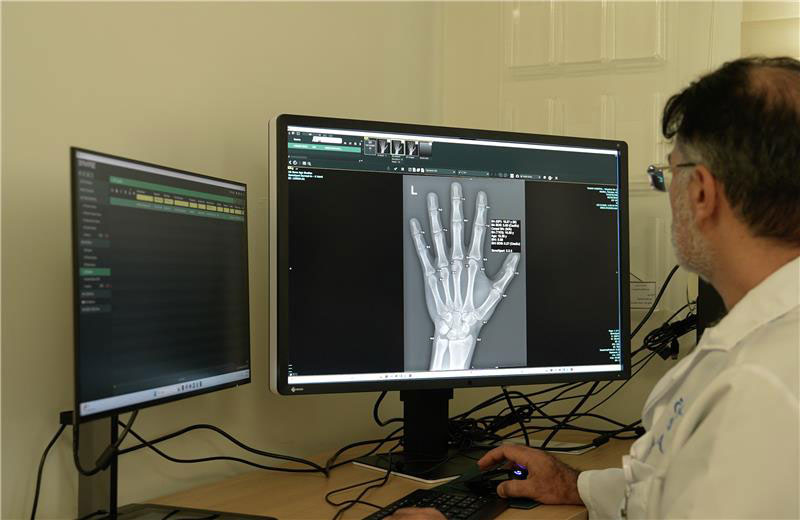
Precision in Paediatric Imaging: Bone Age AI
In paediatric radiology, accuracy and consistency are essential—particularly in bone age assessment, which informs the diagnosis and management of growth disorders.
The implementation of Bone Age AI supports standardized assessment, reduces inter-observer variability, and improves turnaround times—allowing radiologists to focus on clinical correlation and patient-centred decision-making.
“Bone Age AI demonstrates how technology can enhance standardization while fully respecting clinical expertise. It is especially valuable in high-volume paediatric services where consistency and efficiency matter most.”
Dr Sarim Ahter, Chair of Diagnostic Services – Al Ain Region & AI Lead, Radiology Vertical
Smarter Everyday Imaging: Chest X-ray and CT Brain AI
AI adoption extends beyond high-acuity scenarios. Chest X-ray AI supports the detection of common yet clinically significant findings, improving efficiency and consistency in busy imaging environments.
Similarly, CT Brain AI assists in identifying urgent abnormalities and prioritizing critical cases—particularly during peak service hours and overnight coverage—supporting safer, more resilient radiology services.
“These tools help reduce cognitive load and support safer radiology services, allowing clinicians to focus on complex interpretation while AI supports timely prioritization.” Dr Sarim Ahter
International Insight
“AI excels at pattern recognition at scale. When combined with clinical expertise, it enables earlier detection and more consistent care.” The Royal College of Radiologists (RCR), UK
Early Detection, Better Outcomes: AI in Mammography
Breast imaging remains one of the most impactful areas for AI-enabled transformation, where early cancer detection directly influences patient survival, treatment options, and outcome.
Within the Radiology Vertical, mammography AI tools are integrated to enhance early cancer detection, reduce recall rates, improve reporting consistency, and optimize radiologist workflow in high-volume screening and diagnostic centres—while maintaining full clinical oversight and rigorous governance.

“Artificial intelligence in mammography empowers the breast radiologist by acting as a consistent second reader. This frees up more radiologist time to work on complex / high risk cases by reducing the time spent on normal cases thus optimizing workflow and enabling more personalized data driven patient care -ultimately improving outcomes while preserving clinical accountability.”
Dr. Nevine Anandan, Consultant Breast Radiologist, Tawam Breast Imaging Unit & Breast Subspecialty Lead, Radiology Vertical
Governance-Led Innovation, Future-Ready Radiology
What differentiates the Radiology Vertical’s AI journey is not only the technology itself, but the governance behind it. Every AI solution is clinically validated, continuously monitored, and implemented under physician leadership—ensuring safety, trust, and sustainability.
“The future of radiology lies in intelligent collaboration—between clinicians, data, and technology. By aligning AI with leadership and patient needs, we are not just transforming imaging—we are redefining how care is delivered.” Dr. Yasmine Maher
“The true power of AI in radiology lies in augmenting human expertise to deliver safer, more timely, and more effective patient care.” Radiological Society of North America (RSNA)