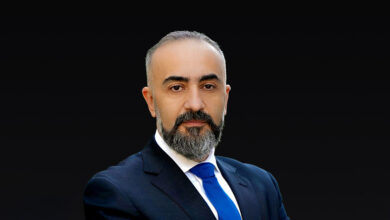
The Connector
How Mounir Khouy came to believe healthcare’s next breakthrough may not be another technology, but better connections.
Walk through any healthcare conference and you’ll notice something that doesn’t happen very often in this industry.
Healthcare comes together.
For a few days, manufacturers, distributors, hospital executives, clinicians, investors, government representatives, consultants, entrepreneurs, and innovators are all in the same place. New ideas are introduced. Partnerships begin over coffee. Business plans are sketched on notepads between meetings. Companies that have never met before suddenly find themselves discussing how they might work together.
There is a reason conferences continue to play such an important role in healthcare. They create an environment where conversations happen faster, relationships develop more naturally, and opportunities that might have taken months to uncover emerge in a matter of days.
For Mounir Khouy, those conversations have always been the most valuable part of the event.
“The exhibition is important,” he says, “but it’s the people you meet that stay with you. That’s where partnerships begin.”
Over the course of his career, Khouy had the opportunity to work with organizations across the healthcare ecosystem. He spent years engaging with manufacturers looking to expand into new markets, distributors searching for innovative products, hospitals evaluating new technologies, governments exploring healthcare initiatives, and investors looking for companies capable of making an impact.
Although every organization had different priorities, they often shared the same objective.
They were all looking for the right partner.
Sometimes that partner was a distributor with local market knowledge. Sometimes it was a manufacturer with a differentiated technology. Other times it was a healthcare provider looking for a solution, an investor looking for an opportunity, or a consultant with the expertise to help move a project forward.
Finding the right organization was rarely impossible.
Finding them at the right time was often much harder.
That observation stayed with Khouy for years.
Looking Beyond the Event
Healthcare conferences have become one of the industry’s greatest strengths because they bring the ecosystem together in a way few other settings can.
Thousands of meaningful conversations take place over just a few days. Relationships are formed, products are introduced, and ideas begin to take shape.
But anyone who has worked in healthcare knows that a conversation is rarely the end of the story.
In most cases, it is only the beginning.
A promising meeting may be followed by technical evaluations, regulatory discussions, commercial planning, procurement reviews, clinical assessments, and conversations involving teams spread across several countries. Additional stakeholders become involved. New questions arise. Opportunities evolve as organizations learn more about one another.
The journey from an introduction to a successful partnership often unfolds over months and, in many cases, years.
Watching that process repeat itself changed the way Khouy thought about collaboration.
He stopped seeing conferences as isolated events and began seeing them as the starting point of much longer relationships.
That realization eventually led to the idea for Venturion.
Not because conferences needed replacing.
Quite the opposite.
Khouy believed there was an opportunity to build something that complemented them by helping organizations continue the conversations they had already started and discover new opportunities between one event and the next.
“The future of healthcare isn’t only about creating better technologies,” he says. “It’s about helping the people behind those technologies connect with the organizations that can bring them to life.”
A Different Way of Looking at Healthcare
Healthcare is often described as a technology industry.
There is certainly no shortage of innovation. Every year, new medical devices, digital platforms, artificial intelligence applications, diagnostics, and therapeutic solutions enter the market with the promise of improving patient care.
Yet technology alone rarely determines whether an innovation succeeds.
Success depends on people.
A manufacturer may develop an outstanding product, but it still needs commercial partners, distributors, healthcare providers, regulators, educators, and investors to bring that innovation to market. Each organization contributes something different, and each plays a role in determining whether a solution ultimately reaches the patients it was designed to help.
Khouy came to see healthcare less as a collection of independent companies and more as a connected ecosystem.
Every organization depends on another.
Progress depends on collaboration.
From Observation to Opportunity
The idea behind Venturion did not begin with software.
It began with a question.
What if healthcare organizations had a better way to stay connected after the conference ended?
What if the relationships that started during those few days could continue to grow instead of relying on scattered emails, business cards, and the hope that people would reconnect six months later at the next event?
Those questions shaped the platform’s direction from the beginning.
Rather than creating another social network or online marketplace, Venturion was designed to support the relationships that already exist within healthcare while helping organizations discover new ones that might otherwise never happen.
The platform brings together manufacturers, distributors, healthcare providers, consultants, investors, government organizations, and industry partners in a single environment focused on collaboration.
Its purpose is straightforward.
Help the right organizations find one another.
Relationships Before Transactions
Ask Khouy what success looks like, and he doesn’t immediately talk about users or downloads.
He talks about partnerships.
A manufacturer entering a new region because they found the right distributor.
A hospital discovering a technology that improves patient care.
An investor meeting a company capable of solving an important healthcare challenge.
A government identifying partners that can support a national initiative.
Those are the outcomes he believes matter most.
Healthcare has always been built on relationships.
Technology can make introductions easier.
Trust is still built by people.
That is why conferences remain so valuable.
Nothing replaces a face to face conversation.
Venturion was never intended to compete with those moments. It was designed to help preserve their momentum.
Building a More Connected Industry
Healthcare is becoming increasingly international.
A technology developed in one country may find its largest market on another continent. Distributors are expanding across borders. Health systems are learning from one another. Investment is becoming more global. Collaboration is no longer limited by geography.
As healthcare becomes more interconnected, the ability to identify trusted partners becomes increasingly important.
Khouy believes the next decade will belong to organizations that collaborate effectively across industries, disciplines, and markets.
That does not happen by accident.
It requires environments where relationships can continue to develop long after an introduction has been made.
The Long View
When people talk about the future of healthcare, the conversation often focuses on artificial intelligence, robotics, precision medicine, and digital transformation.
Those innovations will undoubtedly shape the future.
But behind every breakthrough is something much less visible.
People.
People who trust one another.
People willing to share ideas.
People prepared to work together across organizations, countries, and cultures.
Technology will continue to transform healthcare.
Collaboration will determine how quickly those innovations reach the people who need them.
For Mounir Khouy, that simple idea became the inspiration for Venturion.
Not to replace the places where healthcare meets.
Not to change the conversations that already happen.
But to make sure those conversations have somewhere to continue.
Because sometimes the most important part of a conference isn’t what happens during the event.
It’s what happens after everyone goes home.