WCM-Q Research Methods Training: improving research literacy and output among healthcare professionals
“Over half of participants indicated that the program supported them in drafting manuscripts, with a substantial proportion progressing to publication.”
The Research Methods Training program is a dynamic educational initiative designed to equip healthcare professionals with the skills needed to confidently navigate scientific research. An initiative of Weill Cornell Medicine-Qatar’s Division of Continuing Professional Development (CPD), the program was developed in response to a clear regional need, identified through surveys, professional interactions, and insights from medical literature, for stronger research literacy and practical data analysis skills among healthcare professionals.
Research Methods Training is designed for a broad range of healthcare professionals, including physicians, pharmacists, nurses, dentists, allied health practitioners, academics, and researchers at different stages of their careers, from beginners seeking foundational knowledge to more experienced professionals aiming to strengthen their analytical capabilities.
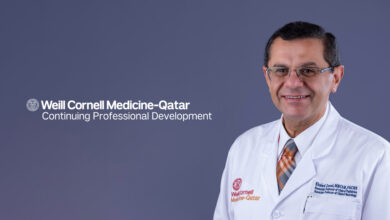
Course creator and director Dr. Ziyad R. Mahfoud is Professor of Research in Population Health Sciences at Weill Cornell Medicine-Qatar (WCM-Q). Prior to joining WCM-Q in 2010, he worked as an Assistant Professor in the Department of Statistics and School of Public Health of the University of Kentucky and an Assistant and Associate Professor in the Department of Epidemiology and Population Health at the American University in Beirut. Dr. Mahfoud holds a Ph.D. in Statistics from the University of Florida. At WCM-Q, Dr. Mahfoud supports several faculty members in the design, conduct, and analysis of research projects. He has initiated a number of training workshops for medical students, researchers and healthcare professionals on topics such as epidemiology, biostatistics, evaluation of published medical articles, and evidence-based medicine. Dr. Mahfoud is committed to improving knowledge sharing and effective communication between healthcare professionals and statisticians.
What gaps does the Research Methods Training program address? And what makes it unique?
The program addresses gaps in research literacy, particularly in understanding statistical concepts, interpreting results in scientific literature, and applying analytical methods to real-world data. Because of the lack of statisticians, clinical researchers should be trained in statistical methods — firstly, to do basic statistical work, secondly, to communicate more effectively with statisticians. We’re giving healthcare professionals the training to enable them to understand statistics, to design studies well, and to analyze their data properly. This will move the research agenda faster.
Healthcare professionals depend on published research to update clinical behavior and clinical care for patients; they should be able to distinguish between good and bad research by understanding statistics, study design, and limitations. A key strength of the program is its breadth and flexibility. It offers both conceptual learning, such as interpreting published research, and practical training that enables participants to analyze their own data using appropriate statistical methods and software. There are workshops on the fundamentals of quantitative and qualitative research, as well as a comprehensive qualitative research workshop. The program has recently expanded to include mixed methods training, providing a well-rounded approach to research capacity building.
What are the main challenges to improving research literacy in the region?
Limited access to practical training, time constraints for busy clinicians, and a lack of confidence in applying statistical concepts. This program is designed to address these barriers through accessible, applied learning.
One of the biggest issues is professionals consuming statistics without fully understanding them. They read articles and accept results at face value.
Another issue is poor communication between clinicians and statisticians; clinicians may not understand the statistics, while statisticians sometimes do not understand the clinical context. Good science doesn’t work like that. When I work on a project, I sit with the clinician to understand the disease, outcomes, and measurements. Some people just crunch numbers without that context. We have a lot of unused data in the region — projects that nobody has analyzed properly. This training helps people start to analyze their own data. Finally, some institutions are reluctant to provide protected time or financial support, which means some professionals must pay out of their own pocket and conduct training in their own time. Some institutions are very supportive; others not at all. To improve research culture, institutions need to provide time and resources.
How is the program structured?
The Research Methods Training program uses a blended approach designed to fit in with the busy lifestyles of healthcare professionals, combining interactive webinars and online workshops with hands-on in-person workshops and short courses. Webinars focus on building foundational understanding, while workshops provide practical experience using statistical tools and real datasets.
We start with the basics—how to read the literature properly; how to understand descriptive and inferential statistics. What is a p-value? What does a confidence interval mean? What are means, standard deviations, odds ratios and hazard ratios?
Topics range from core statistical concepts and critical appraisal of clinical studies to more advanced areas such as survival analysis, sample size determination, and applied biostatistics using software like STATA and IBM-SPSS. In addition, the program covers qualitative and mixed methods research, including topics such as thematic analysis, selecting appropriate methodologies based on different research questions, and integrating quantitative and qualitative findings. This ensures participants gain a comprehensive and practical understanding of a wide range of research approaches.
Each course is reviewed by a scientific committee independent of WCM-Q, made up of diverse healthcare professionals. The committee approves course objectives and content, and courses are accredited in Qatar by the Ministry of Public Health’s Department of Healthcare Professions – Accreditation Section and internationally by the Accreditation Council for Continuing Medical Education (ACCME).
Can you tell us about the Certificate in the Analysis of Medical Data (CAMD)?
This is the flagship offering; a structured, hands-on training pathway designed to equip healthcare professionals with practical data analysis skills relevant to clinical research and practice.
CAMD consists of three progressive workshops—Introductory, Intermediate, and Advanced Biostatistics—typically delivered over three and a half days. Participants complete an assessment after each module to qualify for the certificate. Participants develop the abilities to:
- analyze and interpret medical data
- apply simple and complex statistical methods appropriately, and
- use software such as IBM SPSS to generate meaningful insights from their own research.
The courses typically run monthly — introductory in one month, intermediate the next, advanced the following month. However, the structure is very flexible and professionals do not have to make a continuous commitment.
Follow-up survey data has shown that a significant number of participants achieved the goals they set at the start of the program, including progressing to research outputs such as publications. Further details are reported in ‘Establishing a certificate in the analysis of medical data: a cross-sectional evaluation of a CPD course in biostatistics for healthcare professionals in Qatar’.
Who would benefit most from completing the CAMD?
CAMD is particularly valuable for clinicians, researchers, and healthcare professionals who are involved in research or who wish to strengthen their ability to interpret and apply data in clinical decision-making. It is especially beneficial for those looking to build confidence in analyzing data, critically appraising evidence, and translating research into practice. It is also ideal for graduate students completing their Master’s or Ph.D., as well as residents and fellows.
Evaluation findings have shown that participants not only improve their knowledge and competence, but also their ability to apply these skills in practice. Many reported enhanced performance in conducting statistical analyses, contributing to manuscript development, and supporting research publication. Notably, over half of participants indicated that the program supported them in drafting manuscripts, with a substantial proportion progressing to publication, highlighting its practical impact on research productivity and capacity building.
What has been the impact of the program so far? How may it evolve in future?
The program has attracted a diverse group of healthcare professionals from across the region and beyond, with strong engagement and repeat participation reflecting its relevance and practical value.
The disciplines are highly interconnected: during statistics training, participants sometimes ask clinical questions, and during clinical training they ask statistical questions.
More than 1,000 healthcare professionals have participated in the Research Methods Training program, including over 300 who have completed the certificate course at some level.
Most of the interest is from Qatar and countries in the region – Saudi Arabia, Lebanon, Jordan – but we have also had participants from East Asia and the UK.
The feedback is amazingly positive – 99 percent of the feedback we collect after the training is extremely good. Participants ask for more and more topics — the demand is huge. Future plans include expanding content in emerging areas such as AI and data analytics in healthcare, increasing accessibility through flexible delivery formats, and continuing to align the program with evolving healthcare and research needs.
We’ll continue offering the core courses every year because demand is high. The challenge is finding the time and the right people to deliver high-quality training.
Is the region improving in terms of research culture and literacy?
Yes, definitely. Over the past couple of decades there’s been a big push to improve. There are more courses, open-source platforms, university initiatives, and ministry-led programs.
Most training initially targeted physicians, but now there’s increasing involvement of nurses, public health professionals, and research support staff. Diversity of audience is important.
For further information or to register to attend, visit WCM-Q’s Continuing Professional Development webpage: https://qatar-weill.cornell.edu/continuing-professional-development/