Top questions patients ask before a medical flight
By Michael Hionis, Senior Flight Operations Advisor at Centrale de Vols Ambulance

When people think about medical air transportation, their attention naturally turns to the aircraft. They imagine the onboard medical equipment, the flight itself, and the team waiting to care for the patient.
Yet after years of coordinating international medical transfers, I have learned that patients rarely begin by asking about any of those things.
Questions raised tend to be much more personal instead.
- How soon can my transport be organized?
- Will I be able to travel with my relative on board?
- Will medication be provided during the flight?
- How much does a medical flight cost? What happens if my condition changes before departure?
Each question reflects the uncertainties that accompany severe diseases and injuries away from home, an eventuality that no patient anticipated in advance.
Providing answers is an integral aspect of patient care before departure. Experienced medical flight coordination teams, physicians, nurses, hospitals, insurance companies, and ground teams work in conjunction to ensure the highest standard of medical safety for all stages of transport missions before the aircraft moves at all.
The following are the most commonly asked questions.

How soon can my transport be organized?
Planning usually begins as soon as the initial inquiry is received, even while medical reports or travel documents are still being collected. Behind the scenes, coordination teams work with hospitals, physicians, flight crews, and ground ambulance providers to prepare every aspect of the transfer.
In urgent situations, a medical flight can often be organized within hours, while more complex international repatriations may take longer. The priority is always to move the patient as quickly as possible without compromising safety or the quality of medical care.
Can a family member travel with me?
Among patients, another question raised typically concerns the possibility of relatives traveling with them.
Fortunately, in many instances, this option is indeed feasible.
It is routine practice within air ambulance companies for medically and operationally eligible patients to have one, or sometimes multiple, accompanying relatives aboard, subject to aircraft capacity and the patient’s medical condition.
Not only does this arrangement provide reassurance to both parties, but it also minimizes stress and facilitates effective communication between patients and crew throughout the journey.
Of course, there are occasions when this is not possible.
Transportation in an intensive care aircraft demands additional medical and operational space that cannot host family members. Each case requires individual assessment based on medical necessities and patient preferences.
Even when relatives cannot travel on board, experienced coordination teams maintain close communication throughout the transfer, ensuring families receive regular updates from departure to arrival.
What documents do I need before the flight?
There is a common misconception that all documents must be submitted in advance for medical flights.
In reality, experienced providers usually begin coordinating the mission immediately while the remaining paperwork is gathered.
Key elements usually include the latest patient health report, details on hospitals for treatment and acceptance, identity documents such as passports, and any visa permits required for overseas travel.
Starting the coordination process early often saves valuable time, particularly when international permits, hospital admissions, or cross-border arrangements are required.
What should I pack?
The list is shorter than anticipated. Unlike scheduled commercial airlines, air ambulance transport focuses solely on providing medical support to patients.
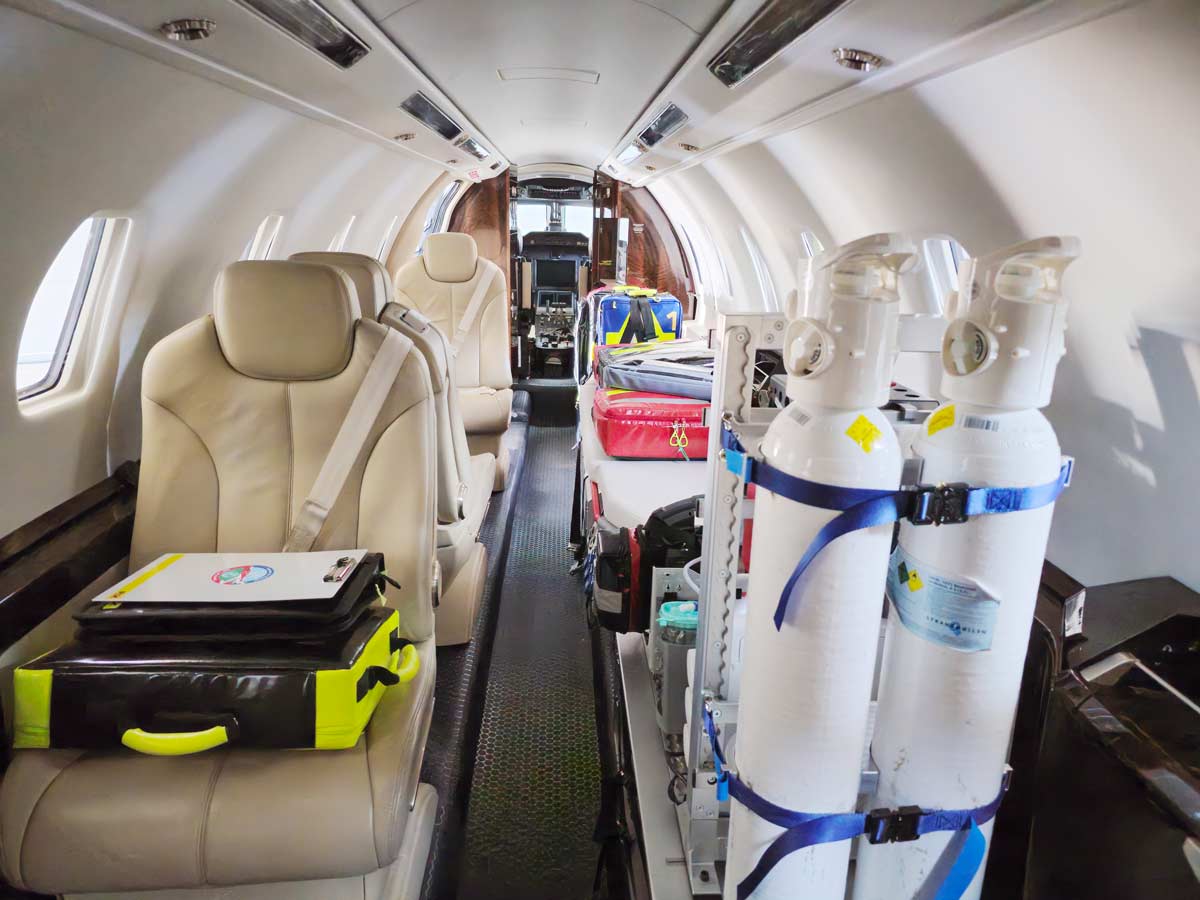
Space within the aircraft is strictly limited for medical supplies, patient monitors, oxygen delivery systems, and crew members’ seats. Patients need to carry only their vital personal items because the maximum capacity of most air ambulances is one item of carry-on luggage, e.g., a small suitcase or a normal-sized backpack.
Documents verifying identity, passport, insurance papers, if necessary, mobile phone and charger, vision correction aids, auditory devices, and crucial clinical files. Comfortable clothing whenever possible, and mobility equipment such as a collapsible wheelchair may be transported if previously declared.
Everything else can usually be arranged later.
Will my medication and treatment continue during the flight?
Quite understandably, patients become concerned about their treatment during air travel, fearing that any treatment administered will be suspended until landing.
On the contrary, medical aviation strives for seamless continuity of patient care from the start to the end of a journey.
A thorough evaluation of each patient’s medical condition, including diagnoses, medications, existing allergies, ongoing therapies, and special requirements, is conducted directly with the respective physician. Only afterward does the aircraft receive a precise medical configuration to suit the patient.
From advanced monitoring and vital support systems to ventilation, oxygen and infusion pumps along with all kinds of emergency pharmaceuticals – everything required is ready prior to patient pick-up.
In essence, the aircraft functions as an extended intensive care facility for the entire duration of a flight until the patient lands safely at the destination.
How much does a medical flight cost?
This is one of the most common questions we receive, and understandably so. Medical air transportation is a highly specialized service, meaning there is no standard price that applies to every mission.
The cost depends on several factors, including the patient’s medical condition, the distance to be flown, the type of aircraft required, the size of the medical team, international permits, ground ambulance transfers, and whether specialist equipment, such as a ventilator or an intensive care setup, is needed.
While patients often focus on the aircraft itself, much of the work takes place behind the scenes. Flight coordinators organize hospital communication, medical documentation, flight permissions, ambulance transfers, and every operational detail required to complete the mission safely.
Transparency is essential, allowing patients and their families to understand exactly what is included and ensuring the transport solution is based on medical need rather than simply selecting the lowest price.
What happens if my condition changes before departure?
Someone who appears stable in the morning may require additional treatment later in the day. Equally, a patient initially considered too ill to travel may improve after further hospital care.
For this reason, every patient remains under medical review until departure.
If circumstances change, the medical director reassesses the mission together with the treating physicians.
Sometimes only minor adjustments are required, such as additional oxygen or different medication.
Other situations may require a larger aircraft, extra medical staff, or specialized equipment.
Occasionally, delaying the flight becomes the safest decision.
While postponements can disappoint families, they reflect the commitment to patient safety that underpins every medical transport mission.
How long does the process usually take?
The amount of time varies depending on the individual circumstances surrounding transport missions.
Although aircraft represent only one component in the planning procedure, medical evaluation reports, reception confirmation at destination hospitals, international permits, ground ambulance arrangements prior to and post-flight, and custom-made preparation of medical equipment for each patient case are examples among many other preparatory processes.
Simple transport missions might be completed swiftly, whilst more complicated international repatriation flights obviously take considerably longer.
Patients should remember that every step exists for a reason. Thorough preparation reduces risk and allows the medical team to focus entirely on providing safe care once the aircraft is airborne.
Who decides whether I am fit to fly?
Perhaps the most important question of all is also one that many patients never think to ask.
Medical evacuation is not arranged solely on the basis of desire. Instead, prior to commencement of any medical transport mission, a medical director thoroughly analyses whether air travel is feasible.
Evaluation is conducted taking into account diverse medical variables related to disease diagnosis, recent surgical history, cardiovascular stability, respiratory capacity, need for oxygen supplementation, neurological status, infection risk, and other factors that contribute to patient safety. Based on the analysis, decisions are made either immediately or after a delay.
Confidence begins before take-off
Medical aviation is often judged by what happens in the air.
Patients tend to remember something different.
They remember whether someone answered their questions. Whether the process was explained clearly. Whether they felt informed during one of the most stressful moments of their lives.
That is why successful medical transportation begins well before take-off. It starts with communication, careful planning, and a commitment to guiding patients and families through every stage of the journey.
The aircraft may carry the patient home, but confidence is built on the ground, one conversation at a time.
About Centrale de Vols Ambulance
Centrale de Vols Ambulance provides worldwide medical evacuation and medical repatriation services, transporting patients who cannot be treated where they are and transferring them to the required destinations on board fast medical jets or with medical escorts on commercial flights.