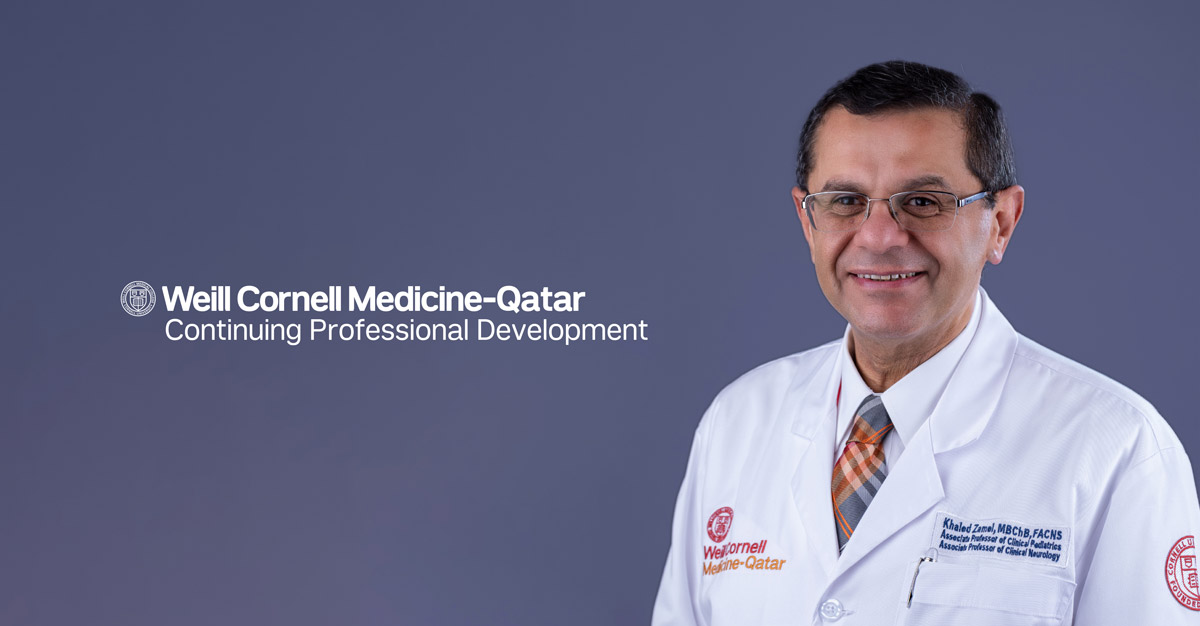
Dr. Khaled Zamel
MD, FACNS, Associate Professor of Clinical Pediatrics & Clinical Neurology, Weill Cornell Medicine–Qatar, and Senior Consultant, Pediatric Neurology, Sidra Medicine
Seizures and Epilepsy in Children: How Qatar is advancing genetic diagnostic research
Epilepsy remains widely misunderstood, both by the public and, at times, the broader medical community, despite being one of the most common neurological conditions of childhood. However, the care of children with epilepsy is being transformed globally as genetic research improves diagnostics and treatment pathways. Over the past decade, we have moved from a one-size-fits-all, medication-only model toward precise, personalized, etiology-based care. Qatar is pioneering regional research in childhood epilepsy diagnostics.
Dr. Khaled Zamel, MD, FACNS, Associate Professor of Clinical Pediatrics & Clinical Neurology, Weill Cornell Medicine–Qatar, and Senior Consultant, Pediatric Neurology, Sidra Medicine, discusses multidisciplinary diagnosis and treatment of seizures and epilepsy in children, how medical practitioners can deal with parental anxiety, and how Qatar is contributing to exciting research in whole genome sequencing.
Why is there still a lack of understanding about childhood epilepsy among medical professionals?
Epilepsy is a complex disease; it’s not a single entity, it doesn’t present with a single symptom, and it has a broad spectrum of clinical presentations.
A seizure is a single event, a burst of abnormal electrical activity in the brain. What that looks like depends entirely on which part of the brain is involved. The dramatic, whole-body convulsion is only one type (a generalized tonic-clonic seizure).
Many seizures are easily missed or mistaken for something else. Infantile spasms are sometimes misdiagnosed as colic. Absence epilepsy can look similar to daydreaming and may not be picked up until a child is referred for an electroencephalogram (EEG).
For many families, no scenario is more frightening than the febrile seizure, a convulsion triggered by fever in children typically aged between 6 months and 5 years, affecting some 3–5% of young children. However, the overwhelming majority of febrile seizures are brief, harmless, and outgrown with no lasting effects. Other presentations include a sudden loss of muscle tone causing the child to drop or slump (atonic); or, in focal seizures, repetitive movements such as lip-smacking, fumbling with the hands, or twitching confined to one part of the body.
Epilepsy is the tendency to have recurrent, unprovoked seizures. This distinction is still widely confused by the public: a child who has one seizure does not necessarily have epilepsy.
Most childhood seizures are brief, self-limited, and not dangerous in themselves. The fear they provoke in families is often out of proportion to the actual medical risk, which is why education and reassurance are such an important part of our work. Approximately two-thirds to three-quarters of children achieve sustained seizure control with appropriately selected anti-seizure medications.
The causes of epilepsy are also very diverse. It may be genetic, or due to a congenital brain malformation, structural abnormalities, immune disorders, or even a previous head injury. Because presentations and causes vary so widely, epilepsy is not always straightforward for non-specialists to recognize and understand.
The single biggest shift in recent years is the rise of genetic diagnosis. Depending on the clinical context, particularly in early-onset epilepsies and developmental epileptic encephalopathies, genetic testing may identify an underlying cause in 30–50% or more of patients. How is Qatar contributing to this research?
A genetic diagnosis can directly change treatment, telling us which medications to choose and, just as importantly, which to avoid because they could worsen seizures in certain conditions. It also helps us predict the course of the illness and offer families informed genetic counseling.
One of the strengths of practicing in Qatar is the remarkable diversity of our population, a mix of Qatari nationals and expatriate families. This makes our patient population an unusually rich, international cohort, and gives our research broad relevance. There is also a relatively high rate of consanguinity, which contributes to a larger share of genetic and inherited epilepsies, with direct implications for diagnosis, treatment, and genetic counseling.
One particularly important development is the Qatar Genome Project, which studies the genome of Qatari citizens. A significant part of that work is carried out at Sidra Medicine through whole genome sequencing, a highly sophisticated form of genetic testing performed entirely in-house by Sidra teams.
Although epilepsy is one area of focus, there has also been significant research in conditions such as autism. I think we will continue to see important discoveries emerging from this project in the future.
Also, Sidra conducted a large study of more than 1,400 children with epilepsy between 2016 and 2019, utilizing whole exome sequencing results from commercial laboratories to establish the first detailed picture of childhood epilepsy in the country*.
Our study used whole exome sequencing to identify disease-causing genetic changes in roughly half of patients, including a number of novel variants, and explored the growing overlap between genetic and immune mechanisms in epilepsy. This underscores why genetic testing, paired with counseling, is so important in our specific population.
Meanwhile, having whole genome sequencing available in-house and studying such a diverse population puts our research teams in a strong position to identify new genetic causes of epilepsy and fill gaps in international knowledge.

How is the partnership between Weill Cornell Medicine-Qatar and Sidra Medicine advancing research into childhood epilepsy?
Weill Cornell Medicine-Qatar (WCM-Q) has contributed significant faculty support, collaboration, and specialist knowledge to the large-scale genetic research being carried out by Sidra teams. WCM-Q and Sidra Medicine are both members of Qatar Foundation and have worked together since Sidra’s launch in 2016; we remain closely affiliated and continue to share resources while supporting each other’s research initiatives.
How will genetic therapy benefit children with epilepsy?
Internationally, researchers are currently at a very exciting stage in treatment trials. Nothing is commercially available yet, but this is getting very close, particularly for Dravet syndrome, a severe form of epilepsy often associated with developmental delays and regression. Children with the syndrome frequently continue to experience severe daily seizures even while taking anti-seizure medication.
A successful gene therapy would be transformative because it would address the underlying cause rather than simply treating symptoms. While Sidra’s epilepsy research is focused on diagnostics, we do provide genetic therapies for other neurological disorders, such as spinal muscular atrophy (SMA).
Sidra was among the pioneers in the region providing SMA treatment, which consists of a single injection that costs approximately US$2.3 million – at one point, one of the most expensive medical treatments in the world. However, it is a one-time treatment that can effectively cure what was previously a fatal disease. The earlier it is given, the better the outcome. If children are identified and treated within the first weeks of life, they can have normal life expectancy and neuromuscular function. This success has helped drive the introduction of newborn genetic screening for spinal muscular atrophy in Qatar.
What are the biggest challenges facing medical practitioners treating children with epilepsy?
Anti-seizure medications remain the first and most effective treatment, but roughly a third of children with epilepsy do not respond adequately to medication. Trying one medication after another is not enough; a comprehensive program is essential. The modern toolkit includes:
- Anti-seizure medications: still first-line, with a growing range of newer, better-tolerated, more targeted agents.
- Dietary therapy (the ketogenic diet): a genuinely effective option for some children. In a regional study involving our center, it achieved meaningful seizure reduction in a high proportion of children with genetic syndromes, with the best responses in conditions such as Lennox–Gastaut and Dravet syndromes.
- Surgery: can be curative or dramatically reduce seizures in some cases; it remains one of the most under-utilized yet most effective treatments for drug-resistant epilepsy.
- Neuromodulation: vagus nerve stimulation and, increasingly, deep brain stimulation offer options for children who are not candidates for surgery.
The overarching theme is a shift away from “try another pill” toward personalized, cause-based treatment, matching the therapy to the underlying cause.
Sidra Medicine now provides world-class, complex epilepsy care for people in Qatar, including citizens, residents, and international patients, so families no longer have to travel abroad for treatment. How does your pediatric epilepsy program work?
Our program manages even the most complex cases through a fully integrated, multidisciplinary approach based on international, evidence-based standards:
State-of-the-art neurophysiology laboratory, including the only dedicated 24-hour video-EEG monitoring unit for children in Qatar. Continuous video-EEG lets us capture and characterize events precisely, distinguishing epileptic seizures from non-epileptic events, identifying specific syndromes, and guiding treatment.
Advanced neuroimaging, including high-resolution MRI as well as PET and SPECT scans for complex cases, essential for pinpointing the source of seizures, particularly when planning surgery.
A dedicated pediatric epilepsy surgery program, made possible by an outstanding pediatric neurosurgery team working hand-in-hand with our neurology team.
Comprehensive genetic testing and counseling, dietary (ketogenic) therapy, and neuromodulation all under one roof.
The outpatient service sees around 50 patients per month. However, the service is less about volume and more about providing highly specialized care.
Are their comparable programs elsewhere in the Arab world?
There are excellent centers across the region, including in Saudi Arabia, and we collaborate closely with many of them on research projects, meetings, and conferences. Sidra also hosts annual international neurology meetings that bring together specialists from all over the world.
One of the most interesting findings from your quality-of-life study** is that children with epilepsy rate their own quality of life higher than their parents do. This suggests caregiver anxiety has a significant impact. How can medical practitioners address this?
I’m very glad you asked that question because it reflects something we deal with every day.
Our quality-of-life study found that attending school and being free of additional medical conditions were associated with better wellbeing, while comorbidities and frequent seizures pulled it down.
Practical messages from the study include:
- Children with epilepsy can and should attend school, play, and participate fully whenever possible. Isolation does more harm than seizures.
- Stigma remains a real burden in our communities; accurate information and open conversation are powerful antidotes.
- Supporting family members, particularly mothers, who often carry the heaviest caregiving load, is part of comprehensive care.
Part of our responsibility is reducing parental anxiety through education and support.
One of the most important things we provide is practical guidance.
We teach families seizure first aid, create rescue plans for prolonged seizures, and make sure they know exactly what steps to take in an emergency.
Another crucial element is providing a clear point of contact. We developed a system using dedicated neurology clinical care coordinators; specialist nurses who act as direct contacts for families and who communicate directly with the treating neurologists to provide rapid advice and reassurance. This service prevents families from feeling isolated and reduces unnecessary emergency department visits.
Education is equally important. Many families initially arrive with misconceptions about epilepsy, including cultural myths about its causes or questions about non-traditional treatments.
We spend significant time explaining the facts, discussing prognosis and helping families understand whether their child’s epilepsy is likely to be self-limiting or whether it requires more intensive long-term management.
This process often takes place over multiple visits. The more time we spend listening to families, answering questions and providing accurate information, the better the outcomes tend to be for everyone involved.
How do you see treatment of epilepsy in children advancing over the next five years?
The future is clearly moving towards more precise and personalized medicine.
Genetic diagnosis is becoming faster and more affordable. As technology advances and more treatments become available, costs will likely decrease over time.
At the same time, we will continue to improve surgery through less invasive technologies such as laser ablation. Neuromodulation devices are also becoming increasingly sophisticated, with smarter systems capable of detecting seizures and responding automatically.
Artificial intelligence is contributing to imaging and data analysis. AI is already helping improve the speed and accuracy of interpreting scans and managing large volumes of genetic information. Overall, genetics will play a major role in the future of epilepsy care, but advances in surgery, neuromodulation, diagnostics, and data analysis will also contribute significantly to improving outcomes for children.
* Benini R, Asir N, Yasin A, et al., Zamel K, Kayyali H, Elestwani S. Landscape of childhood epilepsies – A multi-ethnic population-based study. Epilepsy Research. 2022;183:106936.
** Ahmed F, Ali HA, Musa A, Fawzi M, Benini R. Determinants of quality of life in Pediatric Epilepsy: A study from a single tertiary center. Epilepsy & Behavior. 2026;174:110807.