Operationalizing Green Healthcare with the GIDC Model and GIDC Scoring System
By Mohamed Tawfik, the President of ISCEA KSA

The healthcare sector across the Arab World and the Middle East faces a dual mandate: delivering top-tier patient care while radically reducing its environmental footprint. Hospitals and health systems are notoriously resource-intensive, consuming substantial amounts of energy and water while generating significant clinical and chemical waste. As nations across the region advance ambitious sustainability strategies, healthcare leaders must look beyond basic compliance to drive systemic, value-generating environmental transformation. The Green Income Diversification Creativity (GIDC) Model and its corresponding GIDC Scoring System may provide an actionable, data-driven framework tailored to guide healthcare organizations through this green transition.
The Imperative for Sustainable Healthcare
Healthcare systems contribute significantly to global greenhouse gas emissions through direct energy consumption, pharmaceutical supply chains, and waste generation. For hospitals in the Middle East, transforming into eco-efficient institutions is not merely an environmental responsibility; it is an economic necessity. Sustainable operations lead to:
- Operational Cost Reductions: Lower utility expenses through energy efficiency and waste reduction.
- Resilient Supply Chains: Greater stability through green procurement and localized resource management.
- Enhanced Community Health: Cleaner immediate environments that support long-term public wellness.
Unpacking the GIDC Model in Healthcare
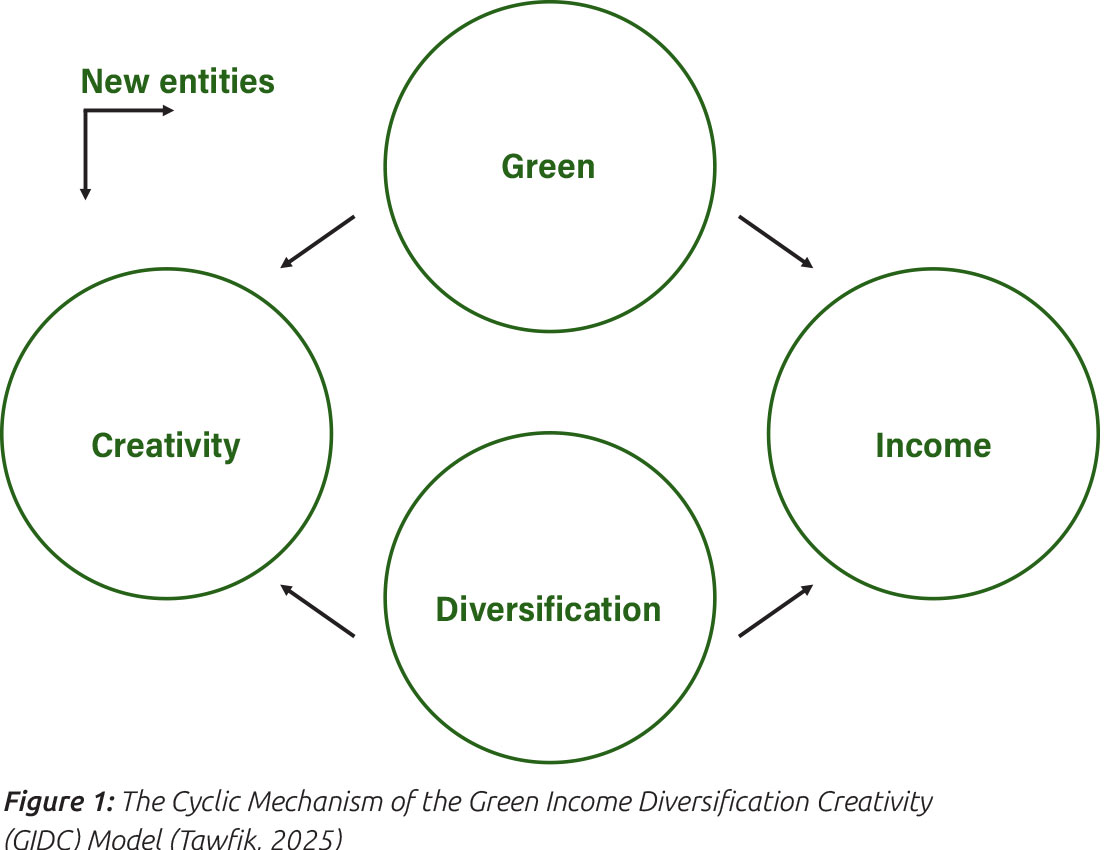
The Green Income Diversification Creativity (GIDC) Model redefines how institutions approach sustainability. Rather than treating green initiatives as pure cost centers, the GIDC framework shows how ecological responsibility can unlock financial efficiency, optimize resources, and create sustainable revenue models. As illustrated in Figure 1, the GIDC Model has four major parameters (green necessity, income, diversification, and creativity) that define it as a robust framework for sustainable growth through green innovation and economic diversification (Tawfik & Merajuddin Inamdar, 2026):
- Green Necessity: Embedding sustainable practices, energy efficiency, and eco-friendly standards across clinical and facility operations.
- Income: Capturing financial returns, utility savings, and value creation unlocked through waste reduction and environmental optimization.
- Diversification: Expanding organizational capabilities into new sustainable revenue streams, asset recovery, and resilient circular supply chains.
- Creativity: Fostering operational innovation, prescriptive analytics, Green AI, and process redesigns that catalyze new entities and continuous institutional evolution.
Empirical Insights & Prescriptive Analytics
Prescriptive analytics tools like Power BI solidify the GIDC Model further by injecting resource optimization capabilities to prioritize projects and make superior decisions under uncertainty.
While the core principles of the GIDC Model are mutually understood across leadership teams, they are emphasized differently depending on cultural and professional contexts (Tawfik & Merajuddin Inamdar, 2026). However, implementation challenges remain, including data availability, system integration, and managerial data literacy. Healthcare managers may appreciate prescriptive analytics as a means to make informed, data-driven decisions based on actionable insights while effectively managing risks and maintaining operational efficiency.
Core Pillars of the GIDC Framework in Healthcare Settings
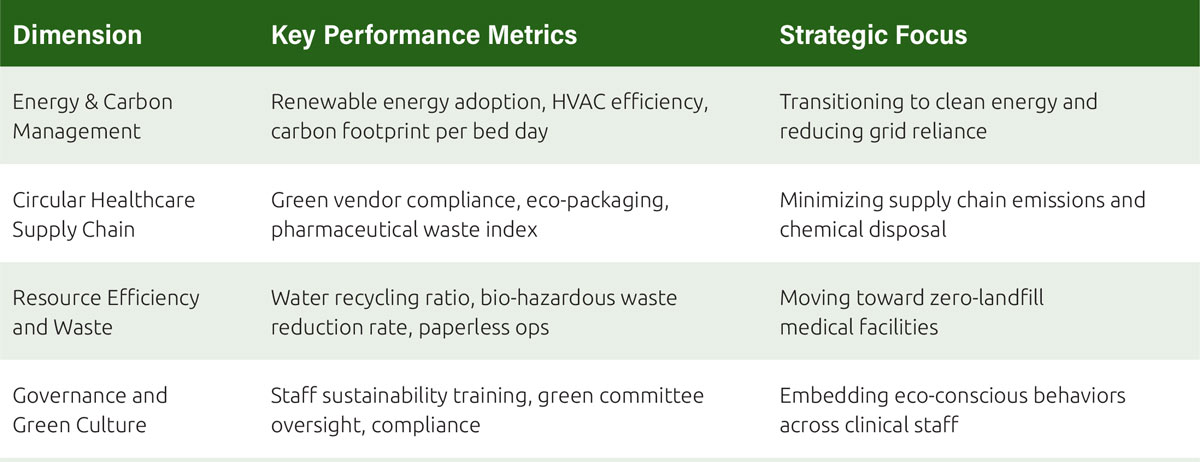
Pillar 1: Resource Efficiency & Waste Reduction; Optimizing facility operations, heating, ventilation, air conditioning (HVAC) systems, and water consumption while implementing rigorous waste segregation.
Pillar 2: Green Supply Chain & Procurement; Partnering with eco-conscious medical suppliers, reducing single-use plastics, and enforcing sustainable cold-chain logistics.
Pillar 3: Prescriptive Analytics & Resource Optimization; Utilizing predictive and prescriptive analytics to identify inefficiencies, prevent pharmaceutical expiration, and repurpose clinical assets effectively.
Measuring Progress: The GIDC Scoring System
To successfully execute green transformation, healthcare leadership requires tangible metrics. The GIDC Scoring System serves as a quantitative diagnostic tool designed to benchmark, measure, and guide a facility’s environmental performance over time.
Practical Implementation Roadmap
Transitioning an established hospital into a sustainable, GIDC-aligned healthcare center requires a structured, phase-based approach:
Phase 1: Comprehensive Sustainability Audit: Assess current energy usage, waste metrics, and procurement contracts. Apply the GIDC Scoring System to establish an initial diagnostic score across all hospital departments.
Phase 2: Strategic Alignment & Governance: Form a multidisciplinary Green Committee comprising executive leadership, clinical heads, facility management, and supply chain directors. Align sustainability targets with hospital budget cycles.
Phase 3: Prescriptive Analytics & Supply Chain Integration: Deploy analytical models to optimize pharmaceutical inventory, reduce drug expiry waste, and digitize administrative processes. Integrate strict eco-procurement criteria for medical equipment.
Phase 4: Facility Upgrades & Operational Optimization: Implement smart energy management systems, low-flow water fixtures, solar integration, and structured clinical waste segregation protocols.
Phase 5: Continuous Review & GIDC Rescoring: Re-evaluate performance annually using the GIDC Scoring System. Share performance milestones with regulatory bodies, accreditation programs, and the broader healthcare community.
The Future of Green Healthcare in the Arab World
As medical facilities across the Arab World and the Middle East look toward a sustainable future, frameworks like the GIDC Model and GIDC Scoring System may help in bridging the gap between high-level environmental goals and practical clinical operations.
By embracing data-backed sustainability frameworks, Arab hospitals can be very efficient in delivering environmentally responsible, high-quality patient care.