A Different Kind of Leadership Address: How Dr. Shamsheer Vayalil Reframed Change Communication in Healthcare
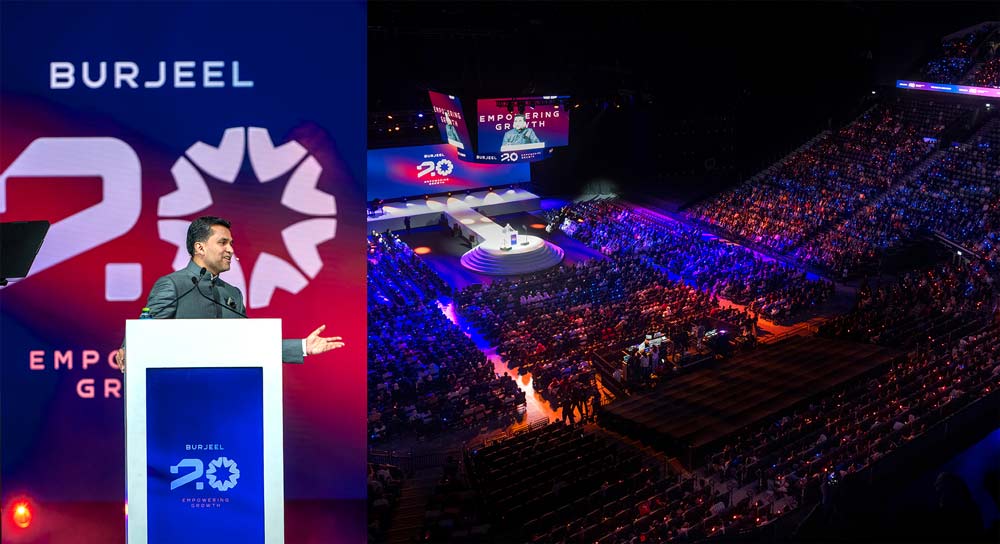
As healthcare organizations grow larger, more complex, and increasingly system-driven, leadership communication often becomes layered, filtered, and distant. Against this backdrop, Dr. Shamsheer Vayalil, Chairman and CEO of Burjeel Holdings, delivered a leadership address that stood out not only for its scale, but for its intent.
Held at Etihad Arena, the address brought together more than 8,500 employees from across Burjeel’s hospitals and facilities, representing a workforce of over 14,000 people. It marked one of the largest internal healthcare leadership gatherings in the region and offered a compelling case study on how leaders can communicate effectively during moments of transformation.
A New Language of Leadership in Healthcare
Rather than positioning the address as a conventional town hall or performance review, Dr. Shamsheer, after assuming the role of CEO in December last year, approached it as a direct conversation with the institution. The tone was personal yet disciplined, focused on clarity rather than spectacle.
In a sector where change is often communicated through policy documents and cascading presentations, the address demonstrated a different approach: one voice, one message, delivered directly to the people responsible for care.
This style reflected a broader shift in healthcare leadership, where credibility increasingly comes not from hierarchy, but from presence. By speaking without layers, Dr. Shamsheer underscored that leadership during change must be felt as much as it is heard.
As Burjeel transitions into its next phase, referred to internally as Burjeel 2.0, the address placed people at the center of change management. Rather than framing transformation as a response to crisis, it was positioned as a deliberate evolution of a mature healthcare platform.
A Rare Coming Together
Large healthcare systems rarely convene at this scale. Bringing together clinicians, nurses, allied health professionals, and support teams from multiple facilities created a shared institutional moment, reinforcing unity across disciplines and roles.
The physical presence of more than 8,500 people in one arena amplified the impact of the message. It transformed leadership communication from an abstract exercise into a collective experience, reminding employees that they are part of something larger than individual departments or facilities.
Recognition of Frontline Contribution
One of the most resonant moments of the address was the recognition of frontline healthcare workers. Dr. Shamsheer announced BurjeelProud, a people-focused recognition initiative, allocating approximately AED 15 million to acknowledge the contribution of those closest to patient care and daily operations.
The recognition was positioned not as a reward tied to metrics or departments, but as a gesture of belief in the people who sustain healthcare delivery under pressure. For many in attendance, this moment reinforced a simple but powerful message: effort on the ground is seen, valued, and respected.
“This is not a reward for a department. This is not tied to conditions. This is not because you asked. This is because you are the people on the ground. I will not be able to stand here if you are not there on the ground,” Dr. Shamsheer told employees.
Beyond recognition, the address offered renewed motivation by clearly articulating the direction ahead. Burjeel 2.0 was framed as an execution-led phase focused on complex care, system integration, accountability, and outcomes that matter to patients and communities.
By aligning purpose, structure, and expectations in a single narrative, the address helped translate strategy into something tangible for employees. Motivation, in this context, emerged not from slogans, but from clarity.
Entrepreneurial Leadership Meets Institutional Scale
Dr. Shamsheer’s dual role as entrepreneur and CEO was evident throughout the address. The message balanced long-term institutional thinking with the decisiveness of a founder’s mindset. This combination is increasingly relevant in healthcare, where organizations must operate at scale while retaining agility and judgment.
The address demonstrated how entrepreneurial leadership can coexist with governance, discipline, and system maturity, offering a model for leading transformation without losing cultural coherence.
As healthcare systems across the region navigate growth, consolidation, and rising complexity, the Burjeel address stands as a reference point for how leadership communication can evolve. It showed that during periods of change, leaders must speak clearly, act visibly, and recognize the people who make transformation possible.