Boston Children’s Hospital – Gene therapy for hearing loss
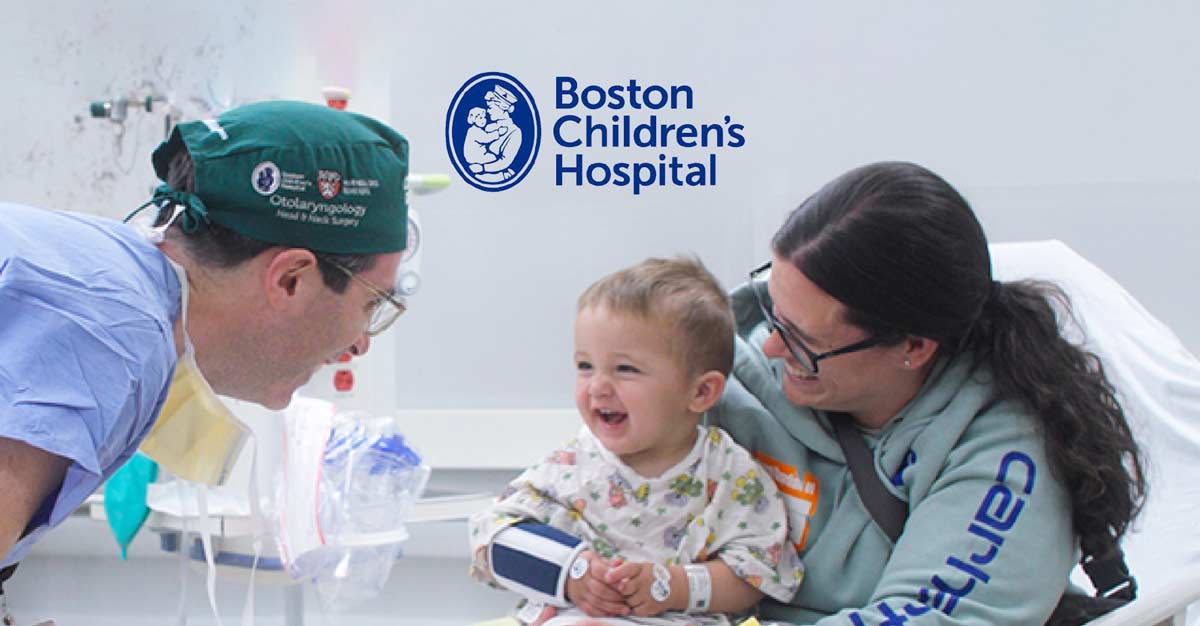
In May 2025, a young boy received an injection delivering a healthy copy of a gene called OTOF into the cochlea of his inner ear — one of the first patients with hereditary hearing loss to receive gene therapy at Boston Children’s Hospital.
The treatment is just the first in a pipeline of gene therapies for hearing loss at Boston Children’s. The team hopes to advance several other gene therapies to clinical trials over the next decade.
Otolaryngologist Eliot Shearer, MD, PhD, sees Boston Children’s — with its large cohort of thousands of patients with genetic hearing loss, a robust group of science discovery labs, and a clinical trials group — as an ideal trial site for gene therapies.
The benefits of gene therapy
Up to 60 percent of children born with hearing loss have an identifiable genetic cause. To date, mutations in at least 150 genes have been implicated in hearing loss. If gene therapy is done early, children can acquire normal spoken language and connect better with others socially.
“The ideal is to do gene therapy once and cure hearing forever,” says Margaret Kenna, MD, MPH, who directs clinical research in the Department of Otolaryngology and Communication Enhancement.
Gene therapy for hearing loss
In May 2025, a young boy received an injection delivering a healthy copy of a gene called OTOF into the cochlea of his inner ear — one of the first patients with hereditary hearing loss to receive gene therapy at Boston Children’s Hospital.
Otolaryngologist Eliot Shearer, MD, PhD, sees Boston Children’s — with its large cohort of thousands of patients with genetic hearing loss, a robust group of science discovery labs, and a clinical trials group — as an ideal trial site for gene therapies.
The benefits of gene therapy
“The ideal is to do gene therapy once and cure hearing forever,” says Margaret Kenna, MD, MPH, who directs clinical research in the Department of Otolaryngology and Communication Enhancement.
TMC1 and “Beethoven” mice
Scientist Jeffrey Holt, PhD, has explored gene therapies for hearing loss for the past 25 years. Holt and collaborators put a stake in the ground in 2011, showing that two related proteins, TMC1 and TMC2, are essential for hearing. The proteins sit atop sensory hair cells in the cochlea. When sound waves vibrate the hairs, TMC1 and TMC2 let calcium into the cells, creating electrical signals that our brains interpret as sound. Holt showed that when the TMC1 gene is mutated, this calcium influx is reduced or lost, weakening hearing.
More than 70 different TMC1 mutations have been identified in humans. In 2015, Holt and colleagues showed that gene therapy providing a healthy copy of TMC1 could restore hearing in deaf mice. They used a harmless engineered adeno-associated virus, called a vector, to deliver the gene, adding a genetic sequence that turns the genes on in sensory hair cells. Holt’s team later showed that CRISPR-Cas9 gene editing can prevent hearing loss in “Beethoven” mice, which carry dominant TMC1 mutations, and that base editing, a more precise technique, could also repair TMC1 and restore partial hearing.
A strategy for delivering large genes
Holt’s lab next explored gene therapy targeting stereocilin, a gene implicated in 15 to 20 percent of genetic hearing loss. Stereocilin enables sensory hair cells to stand tall in a bundle so they can touch the ear’s tectorial membrane — and thereby pick up sound vibrations.
“If stereocilin is mutated, you don’t have that contact, so the hair cells are not stimulated properly,” Holt explains.
However, stereocilin is a very large gene, too large to fit into a viral vector — so Holt divided it between two vectors. In tests, the dual vectors improved hearing in mice with severe hearing loss, sometimes to normal levels of hearing.
A lab-to-clinic pipeline
Holt and Boston Children’s are currently in discussions with potential industry partners to move TMC1 and stereocilin gene therapy into clinical trials. In the meantime, the lab of Holt and Gwenaelle Géléoc, PhD, is developing various other gene therapies in partnership with Karl Koehler, PhD, and the clinical otolaryngology team.
To advance these efforts, Shearer, Kenna, and genetic counselor Shelby Redfield, MS, CGC, have established a Translational Hearing Genomics Lab and a biobank of stem cells from children with genetic hearing loss. One gene of interest is TMPRSS3, which causes hearing loss in thousands of patients. Working with a young adult with a TMPRSS3 mutation and partial hearing loss, Shearer and Koehler are testing potential treatments in mice and inner-ear organoids made from her stem cells. Shearer hopes to develop a fast-track clinical protocol to test the most promising approach in his patient in collaboration with Timothy Yu, MD, PhD, who has pioneered custom genetic treatments using antisense oligonucleotides, a pharmaceutical genetic therapy.
Such advances lead to one crucial outcome: Improvements in patient care. “How we discuss hearing loss with our patients and families is different even from two years ago,” says Shearer. “There are now more options and it informs our decisions.”
Learn more about the Gene Therapy Program:
https://www.childrenshospital.org/services/gene-therapy-program