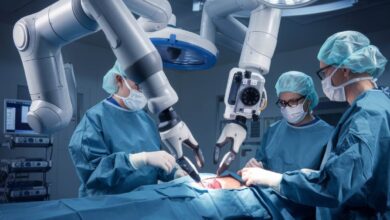
Digital Health and Artificial Intelligence
A Transformational Shift Reshaping the Future of Healthcare

In recent years, the healthcare sector has undergone an unprecedented transformation driven by the rapid advancement of digital health technologies and the expanding integration of artificial intelligence across every layer of the healthcare ecosystem.
These technologies are no longer viewed merely as supportive or complementary tools. They have become central forces redefining healthcare delivery models, shifting them from traditional frameworks based on limited patient interaction toward dynamic, data-driven, predictive, and patient-centered systems.
At a time when healthcare systems worldwide face mounting challenges, including rising healthcare costs, increasing rates of chronic diseases, aging populations, and shortages in medical personnel across certain regions, digital health and artificial intelligence are emerging as strategic solutions capable of bridging critical gaps and improving the efficiency of healthcare delivery.
These innovations also provide unprecedented opportunities to enhance quality of care, improve diagnostic precision, and accelerate clinical decision-making, positioning them as essential pillars in building more resilient and sustainable healthcare systems capable of adapting to future challenges.
The Concept of Digital Health and Artificial Intelligence in Healthcare
Digital health encompasses an integrated ecosystem of technological solutions designed to improve health outcomes and optimize healthcare efficiency. This ecosystem ranges from electronic health records that provide comprehensive patient documentation, to telemedicine services that bridge distances between physicians and patients, as well as smart health applications and wearable devices that allow individuals to monitor their health continuously on a daily basis.
The true value of this ecosystem lies in its ability to collect and analyze enormous volumes of health data in real time, creating an integrated information environment that supports evidence-based decision-making.
Artificial intelligence represents the advanced analytical extension of this digital ecosystem. Through sophisticated algorithms capable of learning from and adapting to data, artificial intelligence can identify hidden patterns that traditional methods may fail to detect.
AI applications within healthcare now extend across numerous domains, from the analysis of medical imaging and clinical documentation to disease prediction and treatment recommendation systems. This enhances the precision and efficiency of medical practice while reducing the risk of human error.
AI-Supported Diagnosis
Diagnosis is among the medical fields that have benefited most significantly from artificial intelligence integration. Intelligent systems are now capable of analyzing medical imaging, including CT scans and MRI studies, with remarkable speed and precision, enabling early detection of numerous diseases, particularly cancers, at their earliest stages.
These technologies also help reduce variability in interpretation among physicians and strengthen confidence in diagnostic decisions.
Alongside imaging applications, clinical decision support systems are playing an increasingly important role. These platforms integrate patient clinical data with vast medical databases that include treatment guidelines and the latest scientific research in order to generate evidence-based recommendations.
Such systems assist physicians in identifying the most appropriate treatment pathways for individual patients, predicting potential complications, and avoiding dangerous drug interactions. In doing so, they improve patient safety and elevate the overall quality of care.
Moreover, these technologies help reduce the cognitive burden on physicians, particularly in highly complex clinical environments that demand rapid and accurate decisions.
Telemedicine and Remote Health Monitoring
Telemedicine has fundamentally transformed the concept of healthcare accessibility by enabling the delivery of medical services regardless of geographical location. This has contributed significantly to narrowing the healthcare gap between urban centers and remote communities.
Its role now extends far beyond virtual consultations. Telemedicine increasingly supports continuous monitoring of chronic diseases and facilitates timely medical intervention, strengthening continuity of care while reducing the need for repeated hospital visits. In parallel, remote health monitoring technologies have revolutionized chronic disease management. Wearable devices and smart sensors continuously collect vital data such as heart rate, oxygen saturation, and blood pressure. When integrated with artificial intelligence systems, these data streams can be analyzed instantly to identify abnormal changes and trigger early intervention before clinical deterioration occurs. This proactive approach marks a major transition from reactive healthcare toward preventive and anticipatory models focused on maintaining health rather than simply treating disease.
Predictive Analytics and Population Health Management
Predictive analytics has emerged as one of the most influential applications of artificial intelligence in healthcare. By analyzing massive quantities of health-related data, predictive systems can identify trends and patterns that help forecast future patient outcomes.
These technologies are used to predict complications, estimate hospital readmission risks, and anticipate the progression of chronic diseases, enabling healthcare providers to implement preventive measures that reduce risks and improve outcomes. On a broader scale, predictive analytics also strengthens population health management. Healthcare organizations can use data-driven insights to identify high-risk populations, design targeted preventive programs, and allocate resources more efficiently. These capabilities also support policymakers in developing evidence-based healthcare strategies, thereby enhancing the effectiveness and responsiveness of healthcare systems in an evolving global landscape.
Enhancing Operational Efficiency and Healthcare Management
Beyond clinical applications, digital health and artificial intelligence play a major role in improving operational efficiency within healthcare institutions.
These technologies facilitate the automation of numerous administrative processes, including appointment scheduling, medical records management, and billing operations. This reduces errors while increasing operational speed and efficiency. They also improve the patient experience by minimizing waiting times and simplifying access to healthcare services.
From a resource management perspective, intelligent systems enable healthcare organizations to analyze usage patterns and forecast future demands related to medications, medical devices, and workforce requirements. This contributes to more effective planning and reduced waste. In addition, these tools support financial and strategic decision-making by providing precise insights into operational costs and institutional performance, thereby strengthening the financial sustainability of healthcare organizations.

Personalized Medicine and Precision Care
Personalized medicine represents one of the most significant outcomes of integrating artificial intelligence with modern medical science. This approach relies on analyzing each patient’s unique biological profile, including genetic information, environmental influences, and lifestyle factors, in order to develop individualized treatment plans that achieve optimal outcomes. This model represents a substantial shift away from traditional approaches that rely on generalized treatment protocols. In oncology, for example, physicians can now select therapies based on the molecular characteristics of a tumor, increasing treatment effectiveness while reducing side effects.
Personalized medicine also improves patient adherence to therapy, enhances the patient experience, and increases long-term treatment success rates, making it one of the defining directions of future medicine.
Challenges and the Road Ahead
Digital health and artificial intelligence offer significant opportunities, but their implementation also brings major challenges. Protecting patient data and privacy remains a top priority as healthcare systems manage growing volumes of digital information.
Clear regulatory frameworks are essential to ensure the safe, ethical, and unbiased use of these technologies. In addition, healthcare organizations must invest in infrastructure, workforce training, and digital readiness to support successful adoption. Reducing the digital divide is equally important to guarantee fair access to innovation across different populations. Looking ahead, digital health and AI are expected to play an even greater role in transforming healthcare through real-time analytics, generative AI, digital twins, and advanced surgical robotics. Integration with technologies such as the Internet of Medical Things and blockchain will further enhance data security, connectivity, and intelligent healthcare delivery.
Technology in the Service of Human-Centered Care
Digital health and artificial intelligence now stand at the center of the global transformation reshaping healthcare systems. They are no longer simply technological tools, but strategic forces redefining how healthcare is delivered and experienced.
Through enhanced diagnostic precision, personalized therapies, predictive capabilities, and improved operational efficiency, these innovations are driving a profound evolution in healthcare quality and patient outcomes.
Yet as this transformation accelerates, responsibility remains shared among healthcare institutions, policymakers, and technology leaders to ensure that innovation is implemented ethically and responsibly, preserving the human values that remain at the heart of medicine.
As healthcare enters a new digital era, one principle becomes increasingly evident:
“The future of medicine will not be defined solely by technological intelligence, but by how intelligently technology is used to preserve humanity in healthcare.”